“The natural world is a world of infinite variety and complexity, a multidimensional world that contains no straight lines or completely regular shapes, where things don’t happen in sequences, but all together, a world—as modern physics tells us—where even empty space is curved. It is clear that our abstract system of conceptual thought can never fully describe or understand this reality.” Fritjof Capra (The Tao of Physics)
In Father Mother Sister Brother, Jim Jarmusch once again surprises with his cinematic approach. For some years now, he has been making films that are supposedly episodic, but which are in reality, as quantum aesthetics would say, “quantum physics,” since the theories of the latter unite Jungian psychology with Bart Kosko’s conceptions of “fuzzy thinking” and Edgar Morin’s “complex thought,” and Fritjof Capra’s “The Tao of Physics.” The new aesthetic starts from the fact that reality is not only exhausted in appearances, but can violate the laws that we consider sensible; the world continues beyond where we had previously believed and does so in an unfamiliar way, violating space, time and causality.
Some scientists have even spoken of the “holographic paradigm” (Ken Wilberg), while David Bohm discussed the “folded order” and the “unfolded order.” The latter would be the external world as we see it, whether through our own perception or through advanced instruments. The “folded order,” on the other hand, would be, when it remains hidden, the source from which manifest reality originates.
In Jarmusch’s concept, the “folded order” would be family gatherings, which begin to unfold with all their mysteries and squabbles, creating a tension that is at times unbearable.
Therefore, these orders exist in Jarmusch’s stories, in addition to a hidden character: the space where these stories unfold. But at the same time, they share a common denominator: romantic relationships, relationships intertwined with social dynamics, and, in this last one, family conflicts involving Father, Mother, Sister, and Brother.
Perhaps Father Mother Sister Brother isn’t entirely autobiographical, but certain statements by Jim Jarmusch allude to the difficult relationship he had with his father, a relationship that was emotionally softened by his mother. Perhaps these memories led him to make this film, to tell us that, when we talk about blood ties, there are certain undeniable truths that transcend any information system.
Father Mother Sister Brother is a film structured in three scenes that revolve around the same reality: the reunion of family members. Siblings who, after several years apart, reconnect, and in this encounter are forced to confront unresolved tensions and reconsider their conflicts with impassive and distant parents. Each story takes place in a different location and country: “Father” is set in a remote town in the rural northeastern United States, “Mother” unfolds in Dublin, and “Sister, Brother” in Paris.
In several recent interviews about his latest film, Jim Jarmusch has cited the basic principle of Zen art, “mu,” the epitaph Yasujiro Ozu had engraved on his tombstone. “Mu” designates what Paul Schrader defined in his book on the transcendental style as “nothingness, silence, and stillness,” but understood in its positive dimension, that is, as a presence. What is left unsaid is, therefore, what is meant: what lies between objects, between words, between people, reveals a truth about relationships and about the world.
“Mu” is a Japanese Zen word that means nothing. There is nothing, emptiness.
In Chinese, it has the same meaning but is pronounced WU.
It is a tool for transcending logic and awakening the mind; it attempts to break down dualistic thinking. It is about breaking down logical thought and provoking a direct understanding of reality. In Zen, this nothingness means that things do not have a physical existence; everything is interconnected, everything is constantly changing. In quantum physics it is also empty but at the same time it is mutation.
That’s why Father Mother Sister Brother isn’t a three-act film, even though it might seem like it: perhaps that’s why there are no commas in the title, because everything flows without any linguistic impediments.
Jim Jarmusch has spent years following in the footsteps of some of his most admired filmmakers, such as the Frenchman Robert Bresson and the Japanese Yasujiro Ozu, essentialist directors: nothing is superfluous, nothing is missing. A void opens up at the end of each shot. The scenes of the children skateboarding and performing ollies in slow motion symbolize existence slipping away before our eyes and the people who come and go in our lives, as well as the total lack of control we have over them. The Rolex watches also represent time that vanishes, disappears, is lost. Our lives are judged by time and the unfolding of history. These shots aren’t filler. They are spaces for emotional breathing, allowing the viewer to process what they have just felt.
The “atmosphere” feels best when the characters are silent, simply existing in the space. The void (the concept of Mu) is what generates the emotional charge.
Furthermore, the film is prolonged by the proliferation of pleasurable moments of stillness in which the characters share, in the light of silence, moments of enigmatic and revealing intimacy. All these traits, which connect Jarmusch to filmmakers like Jean Vigo, Jean-Pierre Melville, and Aki Kaurismäki, reappear in Father Mother Sister Brother, exploring with great serenity and mastery the chiaroscuro of family life and domestic settings.
Jim Jarmusch’s camera, operated by two cinematographers, Frederic Elmes and Yorick Le Saux, subjectively presents an inescapable and subtly provocative piece of minimalism, with voids and sometimes unsettling silences, in which the viewer, in turn, constructs their own story and psychology, as well as imagines what is being observed. What Jarmusch raises is the theme of observer-observed, of presence-absence. As in the third scene, the one set in Paris, where sister and brother (Indya Moore and Luka Sabbat) confront the blurred figure of their father and mother, who died in a plane crash. They are absent but present in their children’s memories.
The serene and distant music, composed by the director himself and Annika Henderson, contributes to this seemingly tranquil yet always tense mood, much like the relationships between parents, siblings, and sisters. No one films those moments of emptiness, where seemingly nothing is happening, with such aesthetic sensibility as Jarmusch.
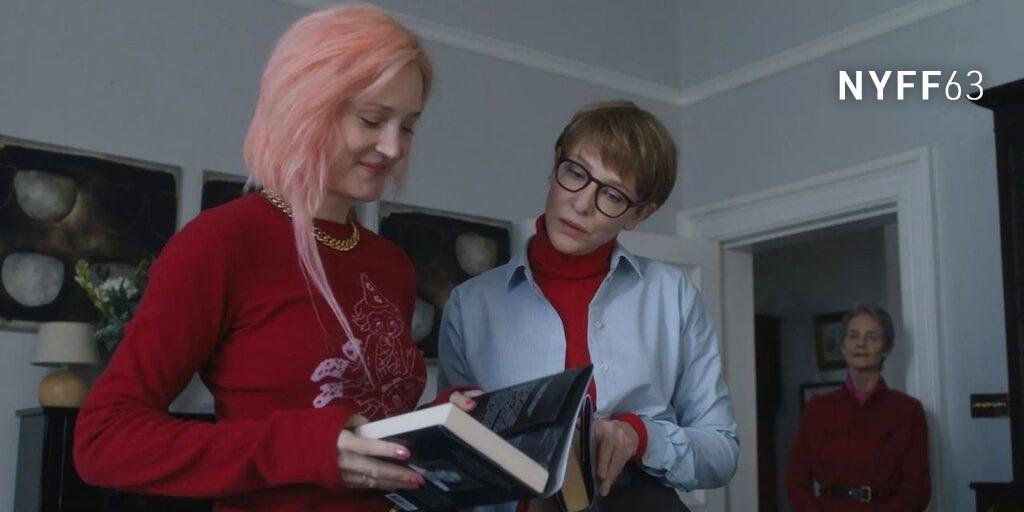
The combination of Mark Friedberg’s production design and Catherine George’s costumes (with input from Yves Saint Laurent, who helped finance the film as a showcase of his own work) provides nonverbal information. For example, in the second episode, the mother, Charlotte Rampling, cold and elegant, and her daughter, Tim (Cate Blanchett), wear blouses of the same red color, while Lilith (Vicky Krieps) wears a red blouse that is partially hidden by an unbuttoned light blue shirt. Warm lighting is used in this segment.
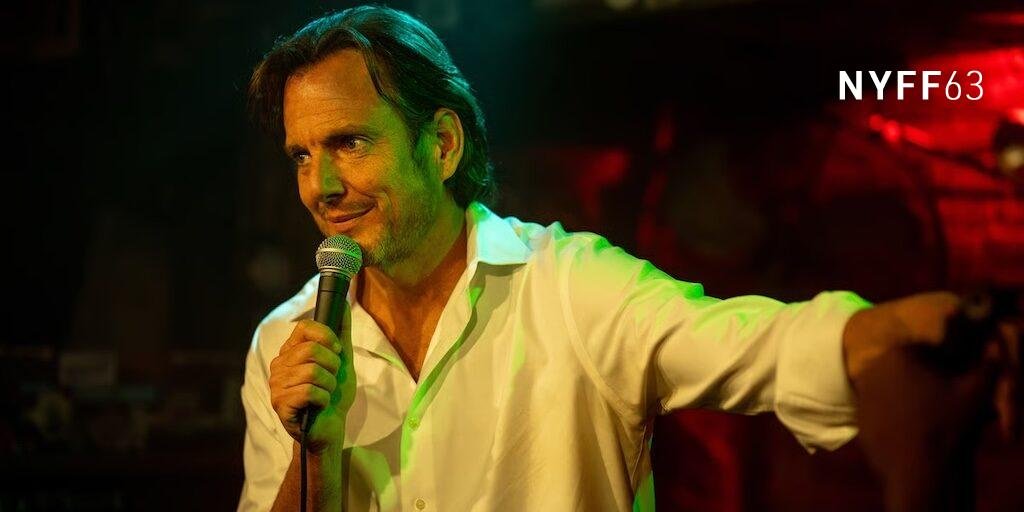
In contrast, the first episode, “Father,” starring the almost iconic actor and friend of the director, Tom Waits, adopts a more humorous tone, employs a cold lighting style, and introduces, for the first time, the use of color as a common element throughout the three episodes: red, purple, and blue. This creates an atmosphere that sustains tension and embarrassment in such a hypocritical and absurd way that it ultimately clarifies for the viewer: as always, appearances are deceiving.
Writer-director Jarmusch has called Father Mother Sister Brother, which he wrote in three weeks, an “anti-action film,” but if you watch it closely enough and in tune with its family-oriented sensibility, it has more action than most genuine action movies, even though much of the action here is off-screen, beneath the surface, unspoken, in the “folded order.”
Jim Jarmusch isn’t aiming for documentary realism, but rather an aesthetic harmony punctuated by the calm of his scenes with vibrant flashes. This is why Jarmusch considers the house or apartment as an object, revealing an innate, one might say, attachment to the primary function of dwelling. According to Gaston Bachelard: “We must ask ourselves how we inhabit our living space, how we take root, day by day, in a ‘corner of the world,’ our first universe, truly ‘a cosmos.’
Every truly inhabited space carries within it the notion of HOME.” And it is then that the sheltered, protected being becomes aware of the limits of its refuge, experiencing the house, in its reality and its virtuality, through thought and dreams. It is the dreams (les rêves) of the various dwellings of our lives that hold the treasures of bygone days, and it is when we find comfort in reliving memories of protection and evoking memories of the house that we add dream values (de rêve); we are then, in a way, poets.
It is in poems, perhaps more than in memories, that we reach the poetic essence of the home. If we ask ourselves, what is the most precious benefit of the home? We can answer that the home: harbors dreams, protects the dreamer, and allows us to dream in peace. Then, the places where dreams have been lived are restored by themselves in a new dream. The home is the first world of humankind. Human beings are placed in the cradle of the home, and always in our dreams, the home is a great cradle. Life begins enclosed, protected, and warm in the lap of the home. When we dream in our childhood home, we partake of that first warmth, and in that environment dwell the protective beings.
Jim Jarmusch is a poet whose writing is cinema, and the screen that projects his vision of the world allows us to dream, analyze, and introspect on ourselves alongside the characters. He is a poet who carries us along on the winds of his imagination to resolve the question: it’s not about considering the house as an object, nor is it about describing houses. On the contrary, we must transcend the problems of description (objective or subjective) to reach the primary virtues, those where an innate, one might say, adherence to the primary function of dwelling is revealed. We must ask ourselves how we inhabit our living space, how we take root, day by day, in a “corner of the world.” The house is our corner of the world, it is our first universe, it is truly “a cosmos.” Seen, and even more so intimately contemplated, isn’t the humblest dwelling the most beautiful? Writers of the “humble room” often evoke this element of the Poetics of Space. But this evocation may seem succinct; there isn’t much to describe about the humble dwelling. It characterizes the humble room in its present state, without experiencing its primitive quality, a quality that belongs to the past. It is in poems, perhaps more than in memories, that we reach the poetic essence of the house’s space. If we ask ourselves, what is the most precious benefit of the house’s space? We can answer that the house harbors dreams, protects the dreamer, and allows us to dream in peace. Then, the places where dreams have been lived are restored by themselves in a new dream. The house is the first world of humankind. Human beings are placed in the cradle of the house, and always in our dreams, the house is a great cradle. Life begins enclosed, protected, and warm in the lap of the house. When we dream in our childhood home, we partake of that first warmth, and in that environment dwell the protective beings.
Everyone, rich or poor, if they accept to dream. Every truly inhabited space carries within it the notion of home. And it is then that the sheltered, protected being becomes aware of the boundaries of their refuge, experiencing the house, in its reality and its virtuality, through thought and dreams. It is the dreams (les rêves) of the various dwellings of our lives that hold the treasures of bygone days, and it is when we find comfort in reliving memories of protection and evoking memories of the home that we accumulate dream values (de rêve), we become, in a way, poets. The house has its own maternal quality. And the poet knows very well that the house holds childhood in its arms.

(United Kingdom, United States, Italy, France, Ireland, Germany, 2025)
Screenplay, direction: Jim Jarmusch. Cast: Tom Waits, Adam Driver, Charlotte Rampling, Cate Blanchett, Vicky Krieps, Sarah Greene. Production: Charles Gillibert, Carter Logan, Atilla Salih Yücer. Duration: 110 minutes.