Throughout human history, the shadow has appeared before our imagination, assuming such diverse forms that it is associated with monsters and other sinister figures. One of the main purposes of literature and art has been to reveal the dark side of human nature.
The concept of the shadow derives from the findings of Sigmund Freud and Carl Jung regarding the dark side of the psyche, referring to unrecognized desires and repressed aspects of the personality.
The analyst Erich Neumann maintains that: “The Self lies hidden in the shadow; it is the one who guards the door, the guardian of the threshold. Only by reconciling ourselves with the shadow and embarking on the path that lies behind it, behind its somber appearance, can we fully recover our Self and achieve wholeness.”
Emily Brontë (writing under the pseudonym Ellis Bell in 1847) managed, in “Wuthering Heights,” to reveal the dark side of humanity, its shadow, before Freud and Jung. In her case, she transformed it into a duality that takes root between the two protagonists (Heathcliff and Catherine) to such an extent that she confesses to her maid that he and she are one and the same person. She compares their bond to “the rocks beneath the earth,” invisible, yet strong and essential.
Their relationship also possesses expressionist elements, a stroke of genius from this writer who anticipated several literary and psychoanalytic movements. One of these is expressionism, in which the antihero becomes the object of sacrifice in order to expose the evils of a corrupt and inhumane society. A characteristic feature of expressionism is that the protagonist is almost always accompanied by a woman who leads him toward his sacrifice.
Published in the heart of the 19th century, “Wuthering Heights” became a classic over time precisely because of its unsettling nature: it doesn’t idealize romantic love, but rather portrays it as riddled with resentment, wounded pride, revenge, and brutal class divisions.
The story of “Wuthering Heights” is complex, exploring obsessive and destructive love in contrast to a redemptive love. It depicts revenge, social oppression, and the repetition of patterns between untamed passion and civilization. The protagonists’ love is based on the point-of-view technique, which allows for a psychological analysis of the characters from within.
The novel’s publication was controversial due to its descriptions of mental and physical cruelty, including domestic abuse, and its challenges to Victorian morality, religion, and the class system.
The characters live not only amidst familial hostility but also in the stormy landscape of the Yorkshire highlands. Emily Brontë set the action of her only novel in the north of England, in the county of Yorkshire, in the incredible locations where everything from Mission: Impossible to The Crown was filmed, and also in Brittany: the Carnac alignments, a series of rock formations that are now a World Heritage Site.
On Booze Moor, the moorland sets near Thrushcross Grange are recognizable, along the paths where the wind still seems to whisper the film’s dialogue. Among the remains of the old OldGang Smelting Mill is the location chosen for the evocative gate of “Wuthering Heights,” a passage between two worlds silhouetted against the leaden sky. The road continues toward the imposing rock formation of Healough Crag.
This version of “Wuthering Heights” by Emerald Fennell, starring Jacob Elordi and Margot Robbie, concludes (for the time being) the 16 existing adaptations made in different countries, among which Buñuel’s Abismos de pasión (1953), set in a Mexican hacienda, stands out.
Emerald Fennell only adapts the first part of the book and eliminates several characters to focus on the narrator’s voice, Nelly Dean, who acts as an alter ego for everyone else.
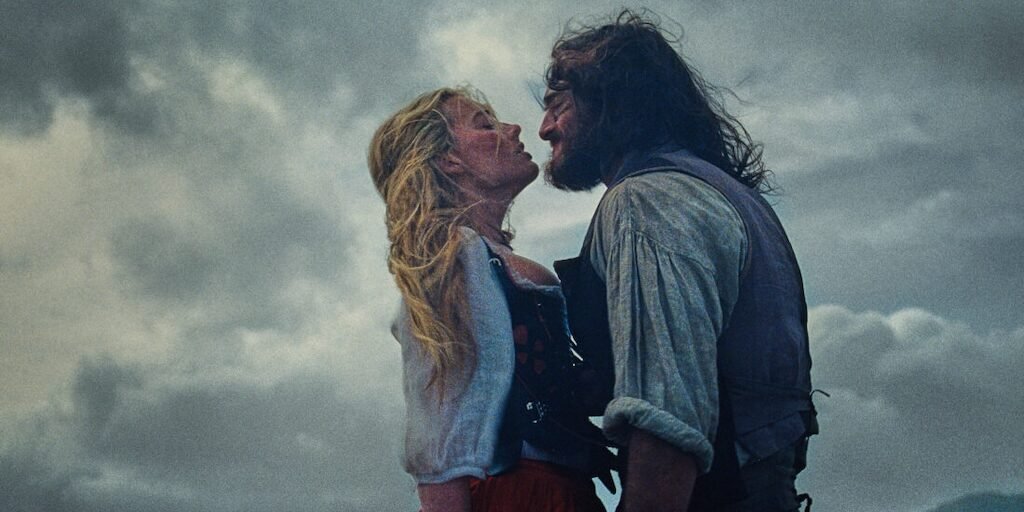
This new version is rather bland despite its erotic undertones, the only redeeming feature being the excellent cinematography. It transforms the arid, gray landscape of the wasteland into flat, legible blocks where the tones don’t clash but rather express the characters’ reactions.
In the style of Yasujiro Ozu, Linus Sandgren’s cinematographer manipulates color to emotionally connect with the viewer. He uses the grays of the exterior landscape not to symbolize tragedy, but to highlight the ordinary. Similarly, the fog simultaneously represents mystery and suspense, as well as a sign of melancholy and acceptance. But the fog is also the ultimate visual representation of the ephemeral, a sensitivity to the beauty of what fades away. The fog appears to remind us that the present moment is fleeting, like the passage of time, or the destruction of a family structure.
The space between the rocks and the surrounding fog acts as a veil, creating an empty space in the love between the characters, where the future is unclear. The fog represents the ineffable, or that which lies beyond physical perception, inviting us into a mysterious and infernal world.
Linus Sandgren emphasizes the use of pillow shots in a poetic exploration of reds against pastel or, in some cases, bright colors, as in the Lintons’ dining room. Catherine wears a vibrant red cloak when she goes to see Heathcliff, at the gate that connects their two worlds, and a softer red dress when they meet again near the moors.
Anthony Willis’s music lends the film a modern yet Gaelic feel, further enhanced by Charli XCX’s original songs from her concept album for the film, commissioned by Fennell.
Wuthering Heights is not only the fog that has shrouded the centuries but also the story of an absurd hero whose love transcends all limits, and like Sisyphus, after Cathy’s death, continues to drag the stone of his love up the hill of sorrow and across the moor in search of a ghost.

(United Kingdom, United States, 2026)
Screenplay, direction: Emerald Fennell. Cast: Margot Robbie, Jacob Elordi, Hong Chau, Shazad Latif, Alison Oliver, Martin Clunes. Production: Emerald Fennell, Rosie Goodwin, Josey McNamara, Margot Robbie. Running time: 136 minutes.